Medicine 3.0: The Future of Preventive Healthcare, Longevity Medicine and Healthy Ageing
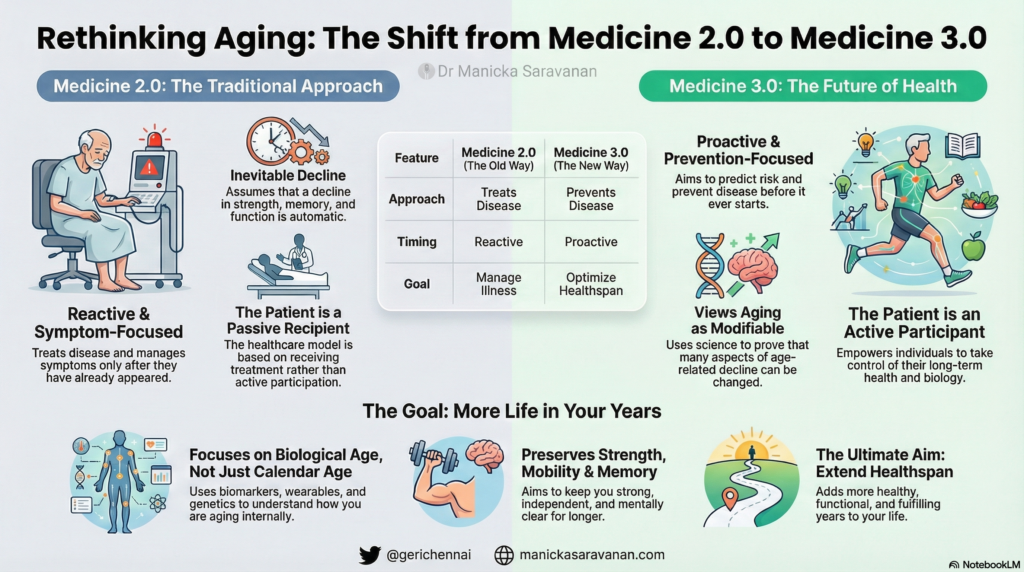
Medicine 3.0 represents a significant evolution in healthcare, focusing on predicting risk, preventing disease, optimising biology, and preserving long-term function. Unlike traditional models that treat illness after symptoms appear, Medicine 3.0 emphasises healthspan as much as lifespan, ensuring individuals remain strong, independent, and mentally clear for as many years as possible.
This modern approach integrates biomarkers, genetics, metabolism, lifestyle data, functional assessments, and advanced diagnostics to understand how a person is ageing internally. It is particularly relevant for adults in mid-life and older adults who want to avoid decline, reduce hospitalisations, and maintain independence.
What Is Medicine 3.0?
Medicine 3.0 is a scientific, personalised, and preventive model of healthcare. It acknowledges that chronic diseases like diabetes, cardiovascular disease, kidney disease, dementia, osteoporosis, and frailty begin silently many years before symptoms. These conditions are driven by molecular processes such as DNA instability, mitochondrial dysfunction, inflammation, metabolic imbalance, and epigenetic changes.
By identifying these subtle changes early, clinicians can intervene long before disability occurs. Medicine 3.0 uses metabolic profiling, advanced blood tests, cardiovascular imaging, continuous monitoring wearables, and assessments of strength, balance, gait, sleep, and cognitive function. This comprehensive view of biological age, not just chronological age, allows for early intervention.
How Medicine 3.0 Redefines Ageing
Traditional models of ageing assumed that decline is automatic. Modern ageing science, supported by global research in longevity medicine, proves that many components of ageing are modifiable. Medicine 3.0 focuses on maintaining muscle mass and strength, improving metabolic flexibility, reducing chronic inflammation, supporting mitochondrial health, enhancing cognitive function, promoting restorative sleep, protecting bone density, and ensuring cardiovascular resilience. This model recognises that healthy ageing is a long-term strategy built over decades.
Where Medicine 3.0 Connects With Geriatrics
Geriatrics has always focused on preserving independence, mobility, memory, balance, and safety. Medicine 3.0 enhances this by applying cutting-edge prevention strategies much earlier. The intersection lies in shared goals: protecting functional ability, reducing frailty, preventing falls, detecting cognitive decline early, reducing hospital admissions, avoiding complications of chronic diseases, and ensuring safe medication use. A geriatric practice informed by Medicine 3.0 identifies at-risk individuals years before they experience limitations and continuously monitors biological age to adjust interventions accordingly.
Biology-Based Prevention for Life
One of the key strengths of Medicine 3.0 is its focus on biological age assessment. Two adults of the same chronological age may differ dramatically in health, strength, stamina, cognition, and metabolism. By analysing VO₂ capacity, gait speed, muscle strength, bone density, blood sugar variability, lipid profiles, inflammatory markers, sleep architecture, and cognitive performance, clinicians can map how fast or slow a person is ageing internally. Targeted interventions—strength training, optimised nutrition, sleep correction, metabolic control, cognitive stimulation—can meaningfully improve long-term outcomes.
Your Personal Longevity Roadmap
A Medicine 3.0-informed geriatric plan includes customised exercise programming, optimised nutrition, medication review, cognitive protection strategies, fall risk reduction, sleep and stress optimisation, cardiometabolic risk reduction, and regular tracking of biological age metrics. This approach reduces dizziness, confusion, falls, sedation, and drug interactions—common causes of emergency admissions in older adults.
Why Early Action Matters
Ageing is inevitable. Decline is not. Most chronic conditions can be prevented or significantly delayed when addressed early. Medicine 3.0 helps individuals maintain independence longer, prevent frailty and disability, preserve memory and clarity, reduce time spent in hospitals, improve energy, stamina, and mood, and extend healthy years of life. The goal is simple: more years of life, and more life in those years. By combining advanced science with personalised geriatric care, Medicine 3.0 offers a powerful roadmap for lifelong health, function, and independence.
Dr Manicka Saravanan,
Consultant Geriatric Medicine,
Dr M S clinic, Adambakkam,
For appointments: 9600925266